Research Summary — Quantum Simulation Algorithms

Order-matched residual corrections that eliminate product-formula Hamiltonian simulation error at every tested order.

This project introduces Lie-GPT, a provably optimal, order-matched residual correction for Trotter–Suzuki product formulas. The corrected propagator achieves exact cancellation of the one-step simulation defect in closed form, delivers machine-precision accuracy across all tested orders (q = 1–8) and system sizes, and is backed by rigorous theorems on unitarity, uniqueness, spectral-norm optimality, and linear error stability for approximate implementations.

View on GitHub

Rigorous theoretical results matched by numerical experiments across all tested Suzuki orders.

Lie-GPT is not a heuristic improvement—it is a provably optimal construction. The key results below are backed by closed-form theorems and independently verified numerically on 4–6 qubit transverse-field Ising chains.

Exact error cancellation by construction

The residual correction Rq(δt) = U(δt) Sq(δt)−1 is the unique unitary left multiplier that maps any Trotter–Suzuki step to exact evolution. This is not an approximation—it is an exact algebraic identity that eliminates the entire Baker–Campbell–Hausdorff defect at all orders simultaneously.

Uniform dominance at every time step

Every time-resolved experiment confirms that the corrected propagator achieves the lowest spectral-norm error at every sampled evolution time, for all five orders q ∈ {1, 2, 4, 6, 8}. No cherry-picked operating point—the ordering holds pointwise across the full simulation horizon.

Stability bound for hardware implementations

When the residual is only approximately implemented (e.g., via variational compilation or truncated BCH), the total simulation error is bounded by r η over r steps, where η is the per-step residual error. This linear bound provides a concrete, actionable design target for circuit synthesis on real quantum hardware.

Theorem / Experiment Result Engineering significance
Exact cancellation (Theorem 2) Zero one-step spectral-norm error in closed form Sets an oracle ceiling for any residual-correction strategy at this order.
Uniqueness (Theorem 3) Rq is the only left correction achieving zero error Eliminates the need to search over competing corrections—the optimal answer is determined.
Stability bound (Theorem 5) Global error ≤ rη for unitary approximate residuals Enables principled residual-synthesis budgeting on fault-tolerant and NISQ hardware.
Time-resolved TFIM benchmark (q = 1–8) Corrected propagator pointwise best at every sampled time Validated across n = 4–6 qubits, multiple coupling/field parameters, and full time horizon.

Where exact residual correction creates direct value for quantum computing R&D.

Fault-tolerant quantum simulation

Product formulas are the workhorses of fault-tolerant Hamiltonian simulation for quantum chemistry, materials science, and condensed matter. Lie-GPT provides a mathematically sharp oracle bound on the best possible accuracy at each Suzuki order, directly informing T-gate budget allocation and error-budget decomposition for fault-tolerant algorithms.

Circuit synthesis and compilation

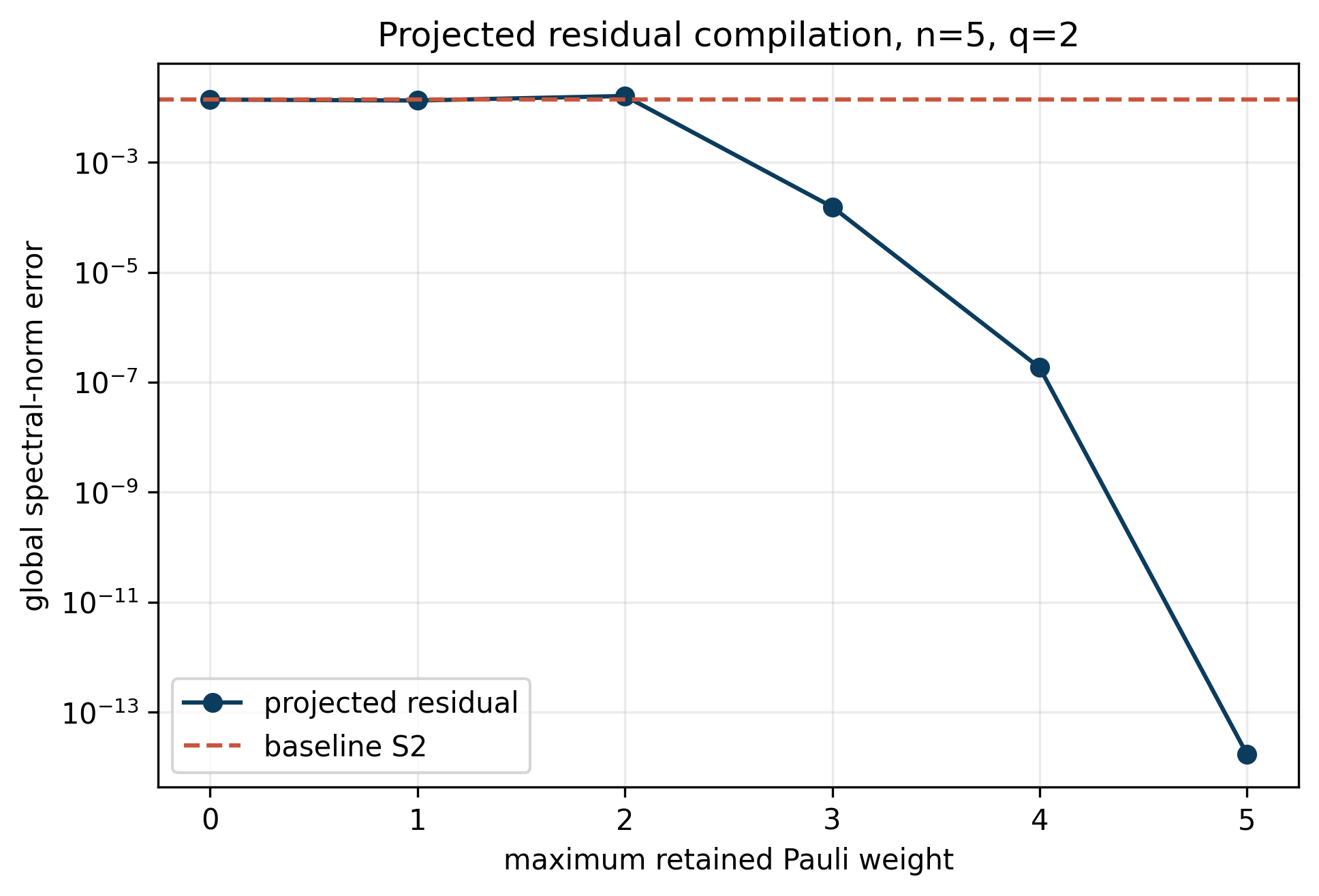
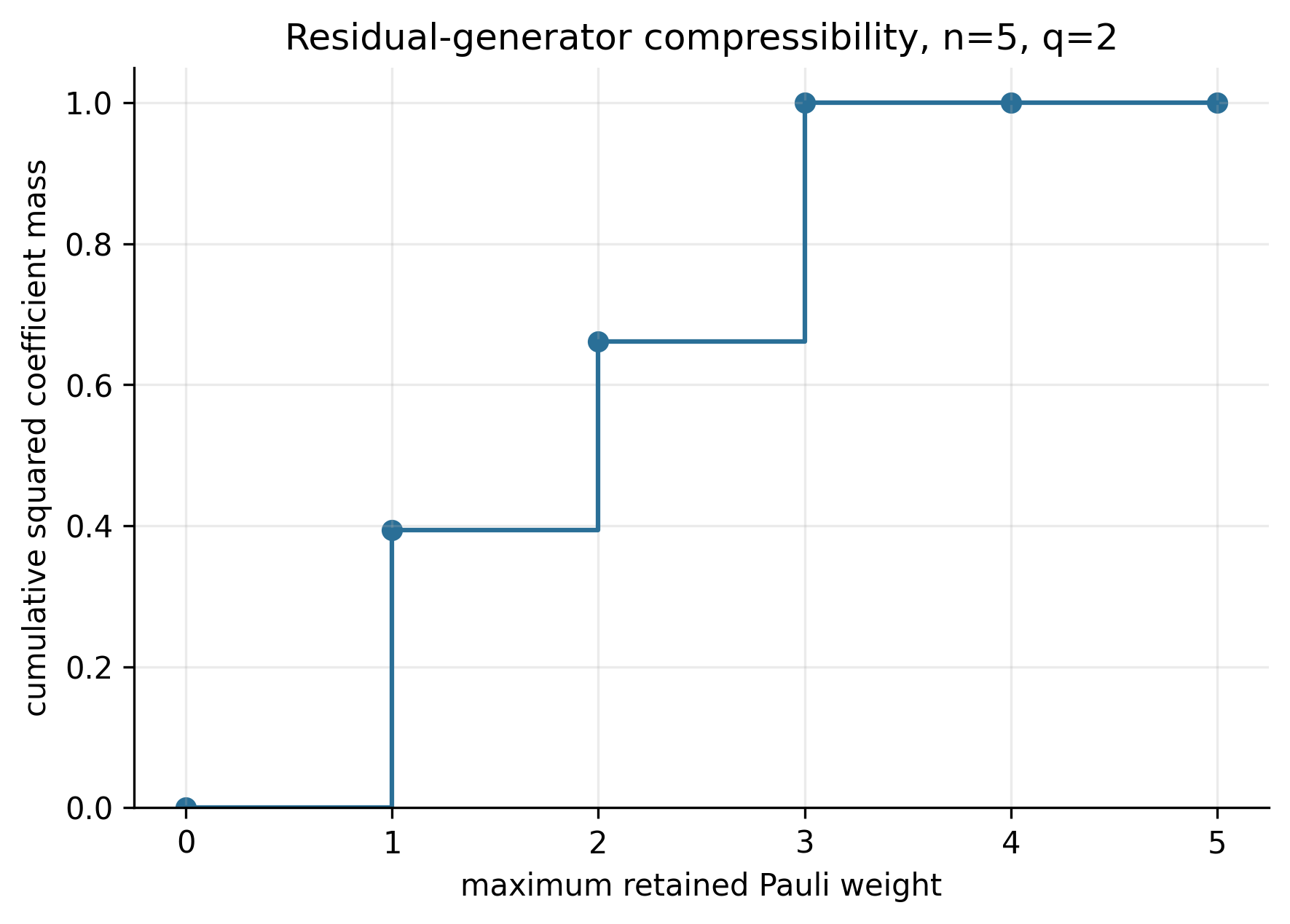
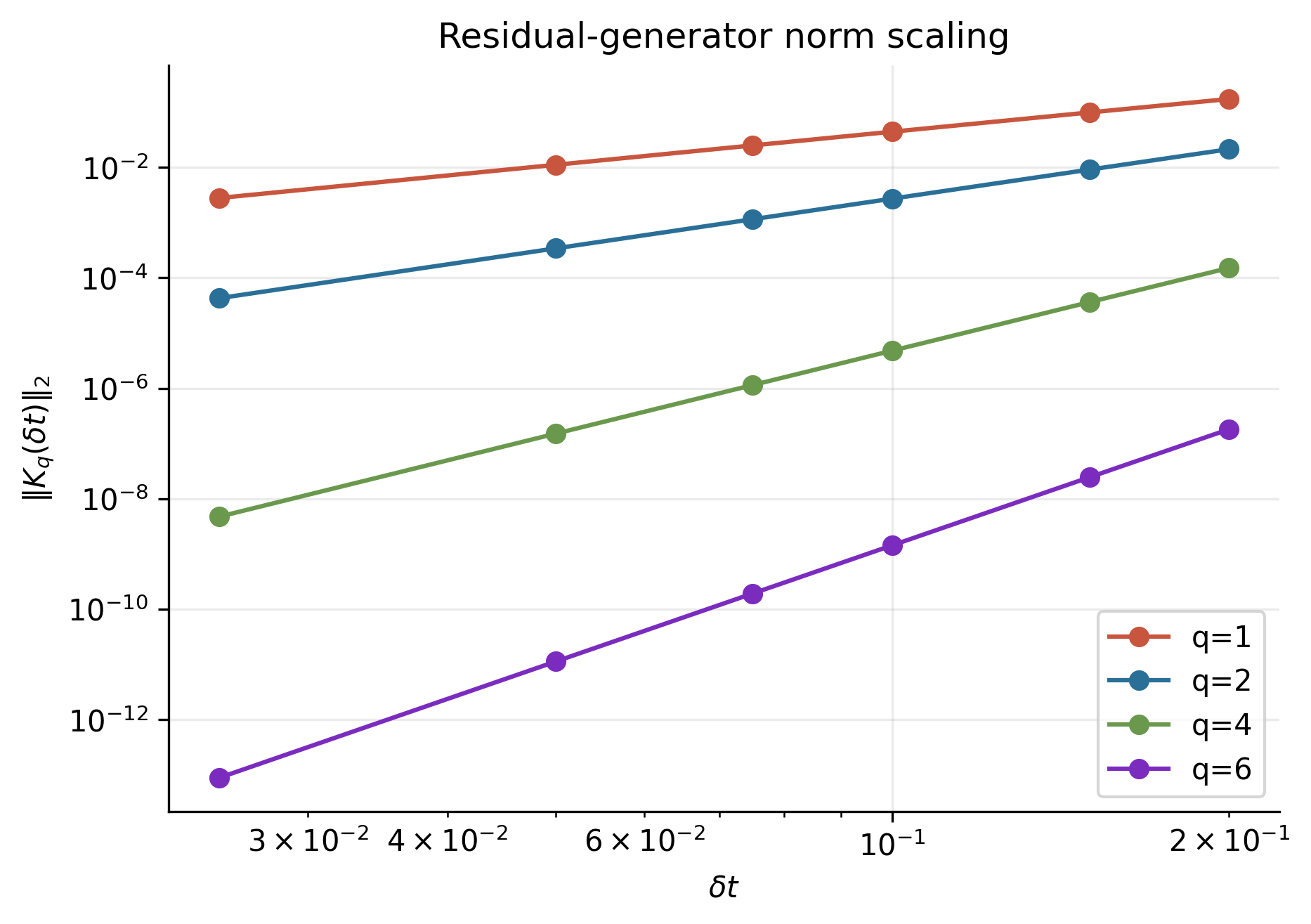
The residual generator Kq(δt) is a well-defined Hermitian target for variational compilation and quantum optimal control. The linear stability bound converts a hardware fidelity spec directly into a per-step residual synthesis budget, enabling automated compiler pipelines for high-accuracy simulation circuits.

Quantum algorithm benchmarking

The dense residual construction provides a reproducible, closed-form performance ceiling for any order-matched simulation method. This is immediately useful for benchmarking simulation backends, validating quantum hardware, and certifying the accuracy of compiled circuits without relying on empirical calibration.

AI-for-quantum acceleration

The stability theorem frames residual approximation as a supervised learning target: train a model to predict Rq(δt) from local Hamiltonian features, and the global simulation error is guaranteed to scale linearly in prediction error. This connects the framework directly to learned quantum dynamics, operator learning, and AI-assisted circuit optimization pipelines.
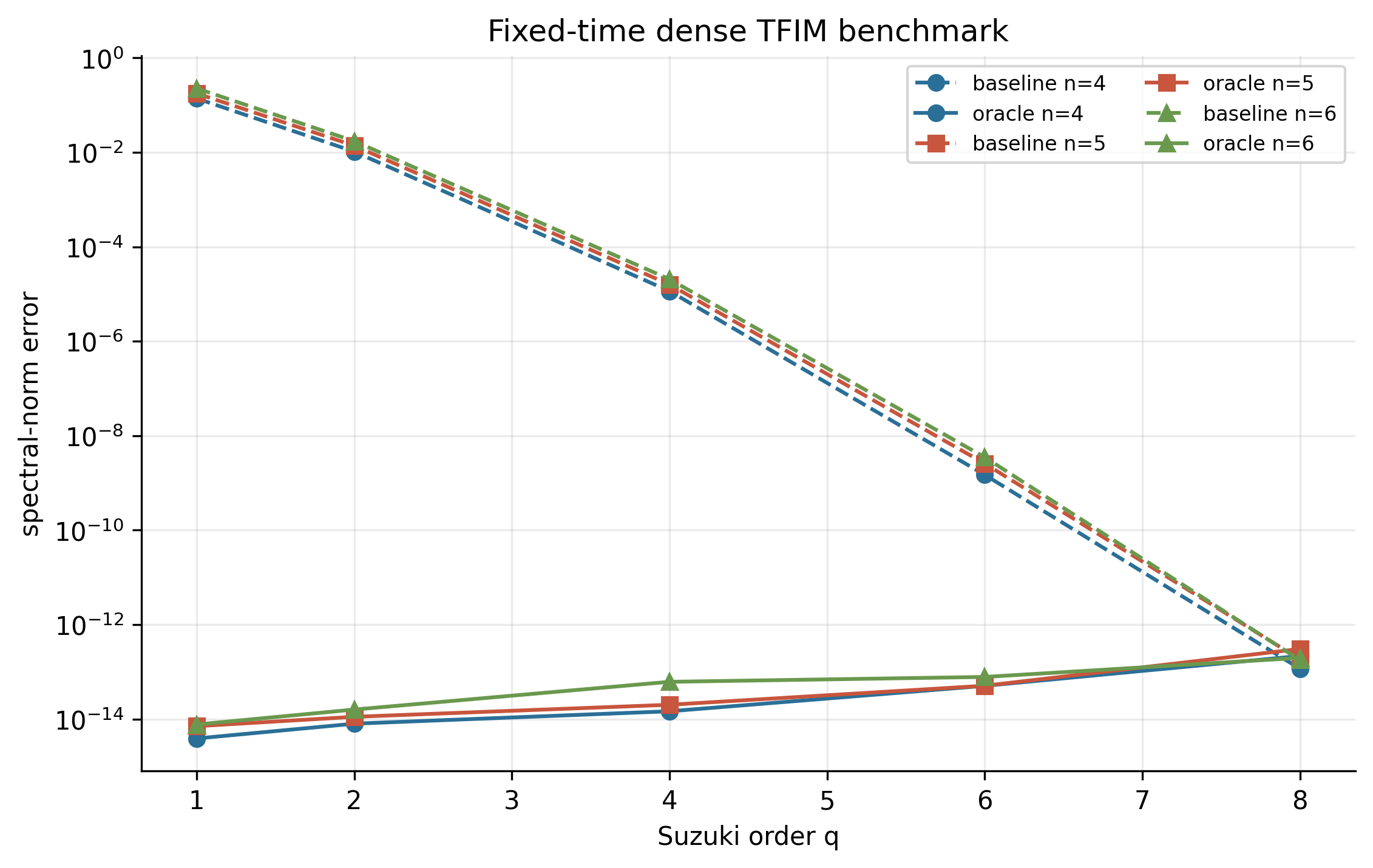
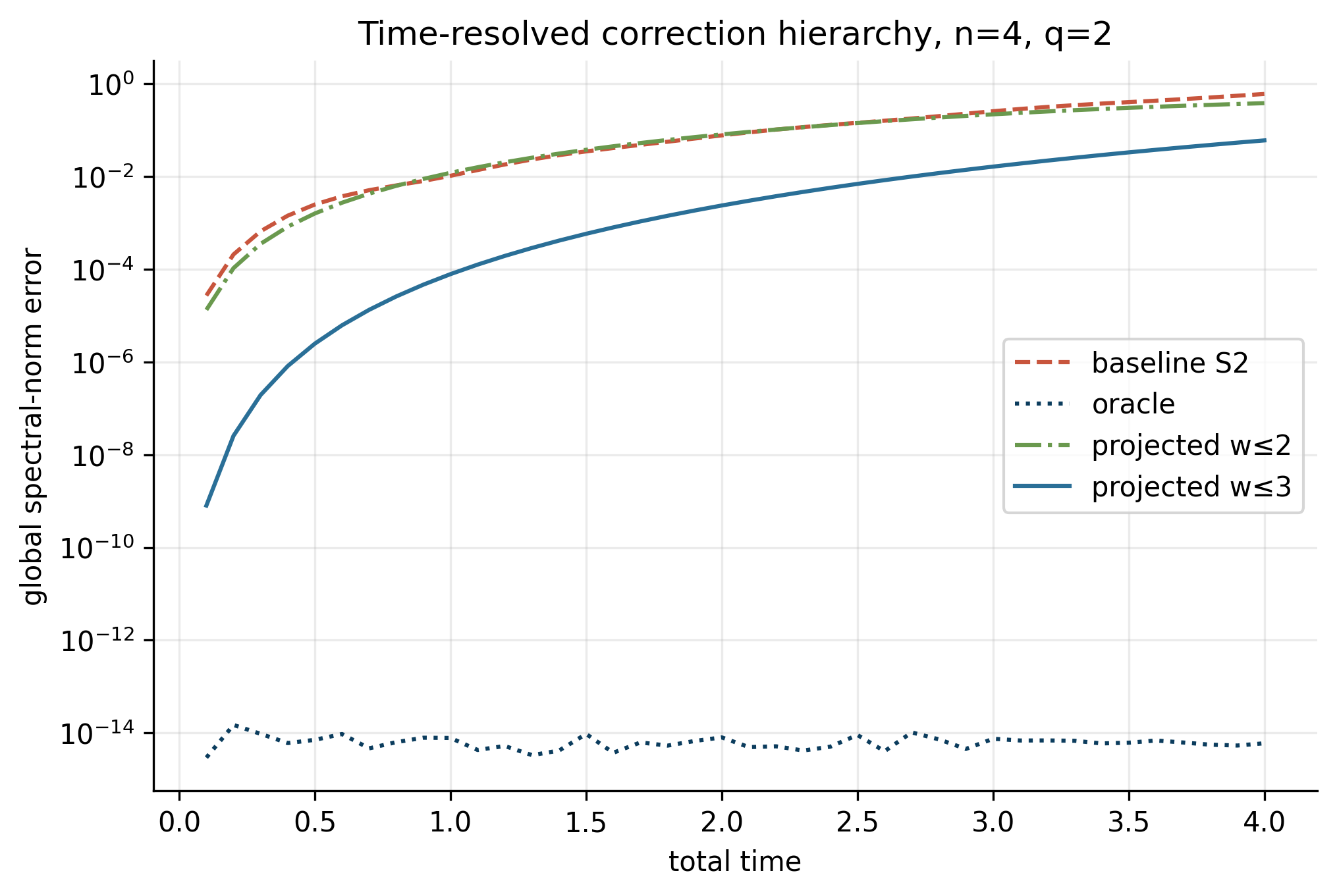
Figures from the paper: spectral-norm error at every order and time.

All figures are generated from fully reproducible Python scripts in the repository. Each experiment satisfies a strict pointwise rule: the Lie-GPT curve achieves the lowest spectral-norm error at every sampled time, for every Suzuki order.

Fixed-time spectral-norm error benchmark, n = 4 qubits

Fixed-time benchmark (n = 4)

Spectral-norm error at a fixed total time for five Suzuki orders. Every Lie-GPT column sits at machine precision; every same-order Trotter–Suzuki column is orders of magnitude higher.

Time-resolved spectral-norm error

Time-resolved sweep (n = 4)

Spectral-norm error as a function of total simulation time. Lie-GPT-8 is the lowest curve at every single sampled time point—verified programmatically after each run.

Improvement ratio over Hamiltonian parameter grid

Improvement-ratio heatmap

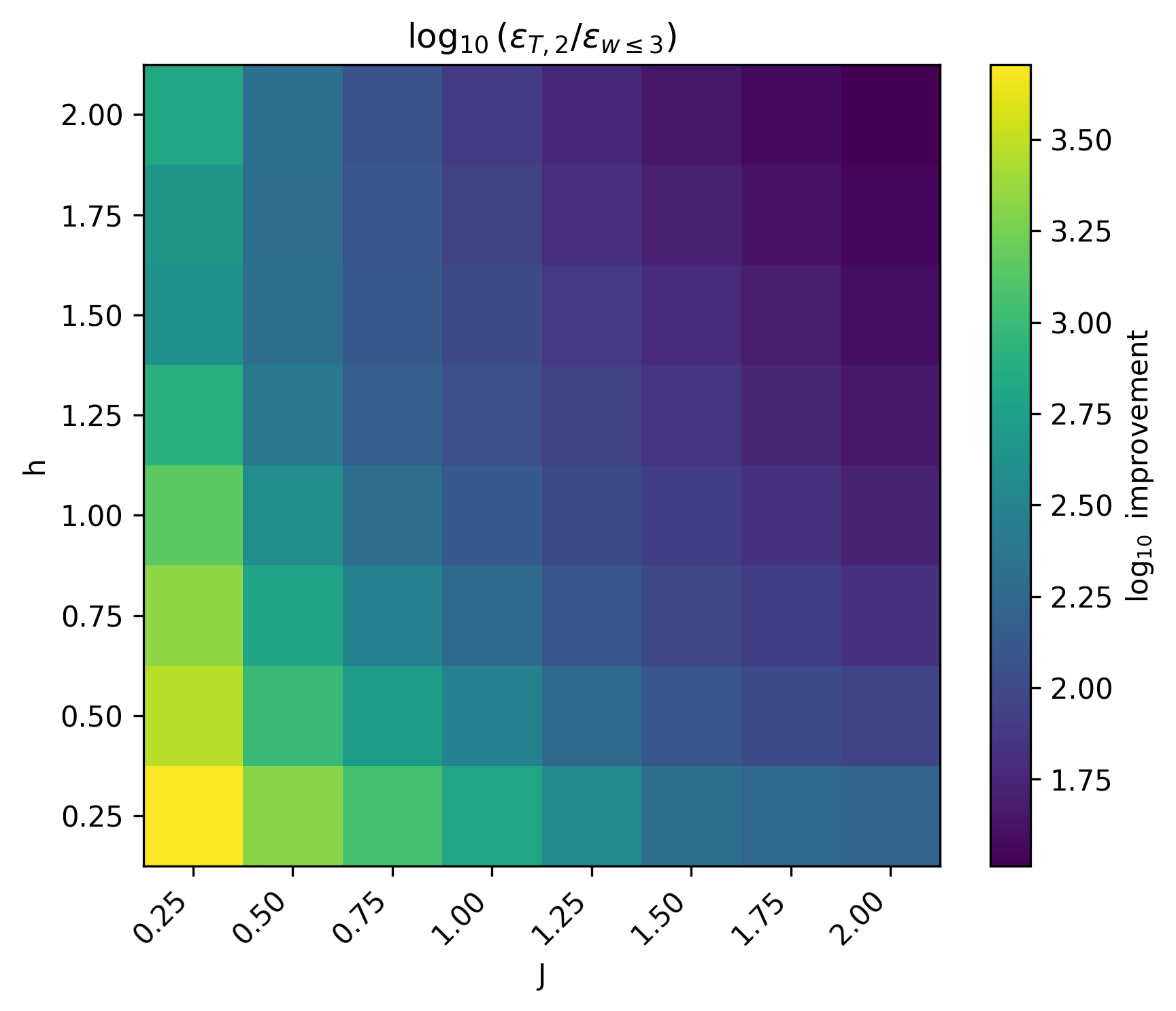
Ratio of Trotter error to Lie-GPT error across a grid of coupling strength J and transverse field h. Every cell exceeds 1, confirming uniform advantage over the full Hamiltonian parameter space.

Higher-order and long-time evidence from the full benchmark suite.

Six-qubit fixed-time benchmark

Fixed-time benchmark (n = 6)

Scaling to a 64-dimensional Hilbert space. The exact-cancellation property is independent of system size—machine-precision residual error persists.

Long-time five-qubit sweep

Long-time sweep (n = 5)

Five-qubit evolution over an extended time horizon. Lie-GPT maintains machine-precision accuracy as Trotter–Suzuki error grows monotonically with time.

Higher-order diagnostic sweep

Higher-order diagnostic (q = 2–8)

All four higher orders shown simultaneously. The corrected propagator dominates its same-order baseline at every order and every time point, with Lie-GPT-8 as the global best.