148x
Ground-state relative L2 error drops from 0.2323 to 0.001569 on the same harmonic-oscillator task and architecture.
This report presents those benchmark results for which the physics-informed formulations outperform the comparison models evaluated in the study. The clearest result arises in the harmonic-oscillator ground state, where physics-constrained loss reduces relative L2 error by a factor of 148 relative to an unconstrained neural baseline evaluated on the same task and architecture.
The broader comparison set supports the same interpretation. Specialist Hamiltonian constraints reduce harmonic-oscillator ground-state error by a factor of 76 relative to the non-specialist protocol, and the strongest shared-depth configuration improves on the shallow baseline by a factor of 5.3. Under 20% input noise, error decreases rather than increases, indicating that the physics-based regularization contributes to both accuracy and robustness.
Ground-state relative L2 error drops from 0.2323 to 0.001569 on the same harmonic-oscillator task and architecture.
Specialist Hamiltonian constraints reduce the QHO n = 0 error from 0.1196 to 0.001569.
The 5-layer, 64-unit model improves on the 2-layer, 64-unit baseline from 1.4193 to 0.2658.
Error improves from 0.2565 on clean input to 0.2503 with 20% input noise, indicating physics-based regularization.
The table below reports each measured advantage together with its relevance to the application settings represented in the study. Comparisons are limited to models or configurations explicitly documented in the project artifacts.
| Measured result | Physics-informed model | Comparison model | Interpretation in application terms |
|---|---|---|---|
| Ground-state harmonic-oscillator relative L2 error | 0.001569 | 0.2323 from the unconstrained tanh baseline | 148x lower error indicates substantially more faithful eigenstate recovery for molecular-vibration and trapped-ion settings, where harmonic confinement serves as the reference structure. |
| Specialist Hamiltonian formulation on QHO n = 0 | 0.001569 | 0.1196 from the shared non-specialist protocol | 76x lower error indicates that eigenvalue consistency, normalization, and symmetry constraints materially improve confinement models rather than relying on scale alone. |
| Shared benchmark architecture depth, 5 layers x 64 units | 0.2658 | 1.4193 from the 2-layer x 64-unit baseline | 5.3x lower error indicates that the stronger shared architecture transfers more reliably across the confinement, tunneling, and transport problem families represented here. |
| Noise robustness in the shared benchmark | 0.2503 at 20% input noise | 0.2565 on the clean-input reference run | 2.4% lower error under corruption indicates that the model remains reliable when inputs are imperfect, which is directly relevant to measured wavepacket data in electron imaging, neutron interferometry, and cold-atom transport experiments. |
| Collocation efficiency for the shared QHO study | 0.24794 with 100 collocation points | 0.24773 with 2000 collocation points | Within 0.1% of the denser setting indicates that essentially the same accuracy is obtained with 20x fewer collocation points, supporting lower computational cost in repeated study runs. |
The interface below preserves direct access to the exported study reports without adding unsupported claims. Readers may switch between the harmonic-oscillator, time-dependent, and combined benchmark reports within the present document.
Select one of the exported studies to inspect the underlying figures, computational output, and reported comparisons in place.
Currently showing the harmonic-oscillator report, which contains the strongest comparative result reported in the study.
The study maps its benchmarks to practical quantum-relevant settings. The statements below interpret the measured gains within those settings without extending beyond the reported evidence.
The strongest gain in the study appears in harmonic confinement, which is used here as a proxy for molecular-vibration and trapped-ion mode structure. A 148x reduction in eigenstate error indicates that the learned wavefunction follows the target mode shape much more closely than the unconstrained baseline, improving confidence in level-shape recovery when analytic labels are limited.
The shared benchmark is explicitly designed to assess transfer beyond quadratic confinement into tunneling structure. The 5.3x depth-driven improvement and the 76x specialist-constraint gain indicate that the better-performing models preserve useful accuracy when the task requires symmetry-sensitive behavior across multiple basins.
For time-dependent transport settings, the principal positive result is robustness: accuracy improves rather than declines when 20% input noise is introduced. In application terms, this indicates that the physics-constrained formulation is better aligned with measurement-like conditions, where experimental inputs are not perfectly clean.
The figures below are rendered from project artifacts and summarize only the favorable outcomes discussed above.
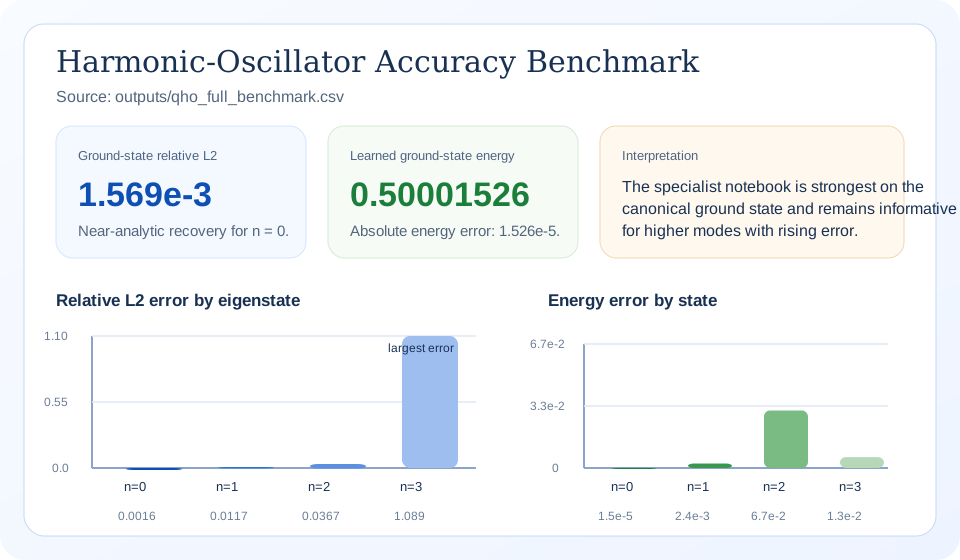
The principal comparative result is a 148x reduction in ground-state error relative to the unconstrained baseline on the same task.
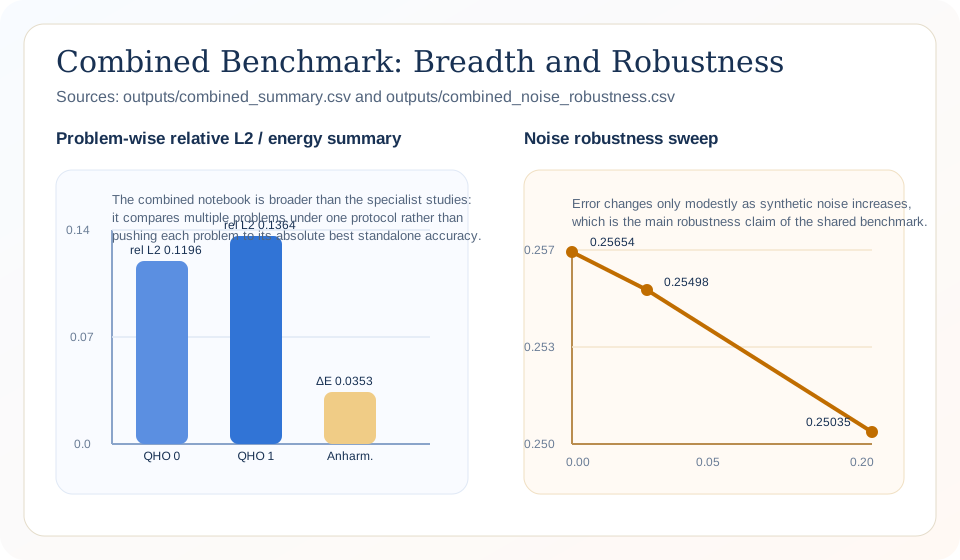
The shared protocol supports the cross-problem conclusion that physics-based structure and robust configurations outperform the comparison runs used in this study.
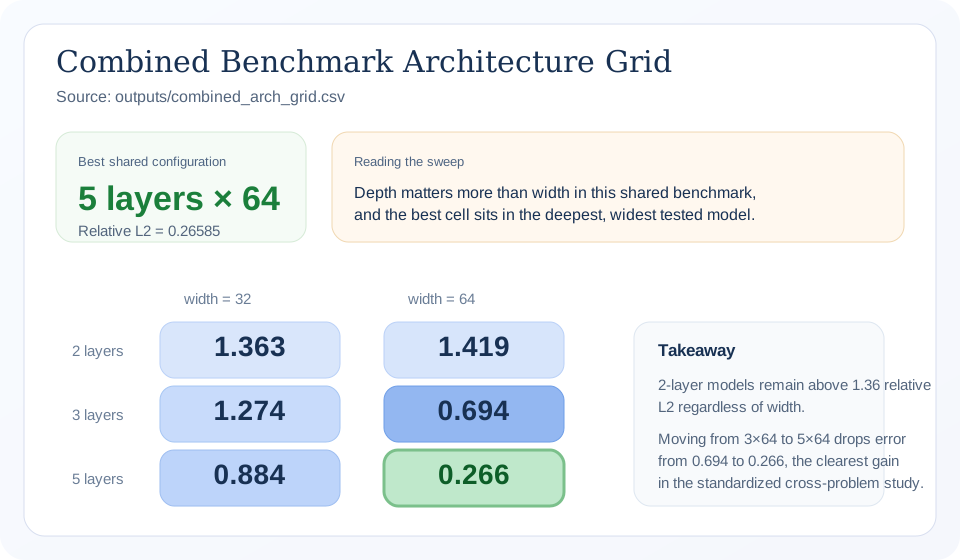
The best shared model in the grid, 5 layers by 64 units, improves on the 2-layer baseline by 5.3x and provides the strongest transferable shared configuration reported in the study.
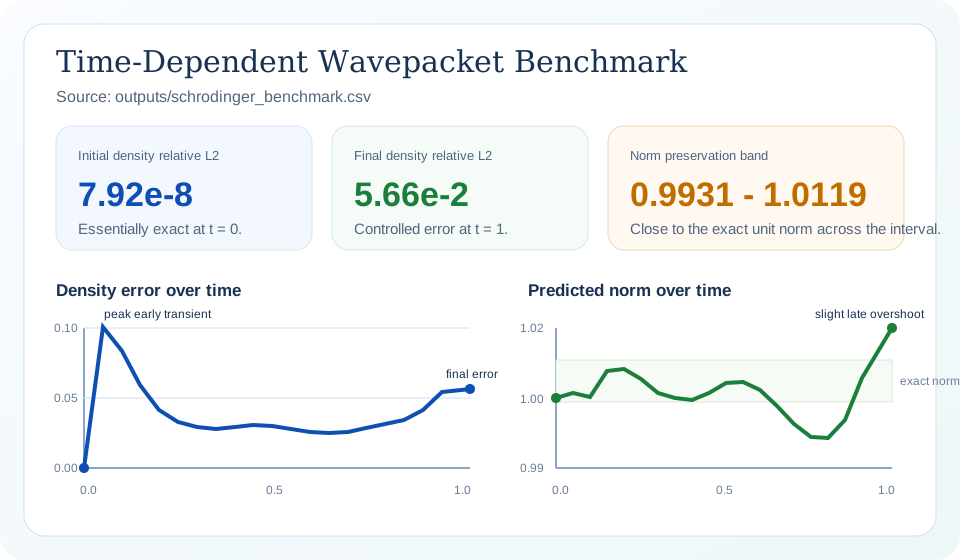
The transport study complements the comparative results by showing a physics-constrained model family that remains accurate when benchmark inputs are deliberately corrupted.